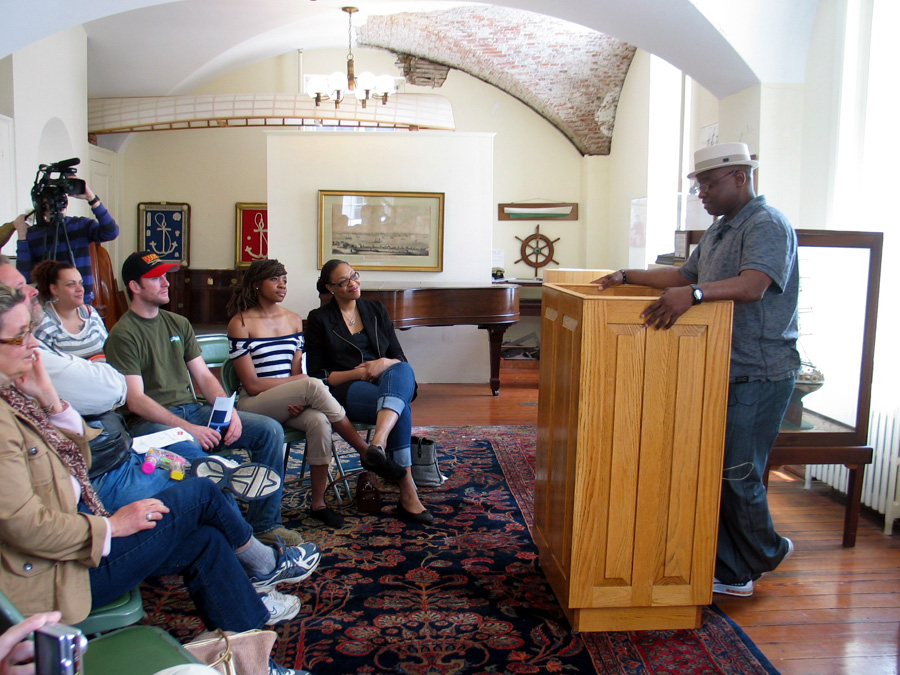
In 2011, the International Festival of Arts & Ideas commissioned original meditations & poems about Connecticut's Freedom Trail sites.
Below are the two pieces written in New London.
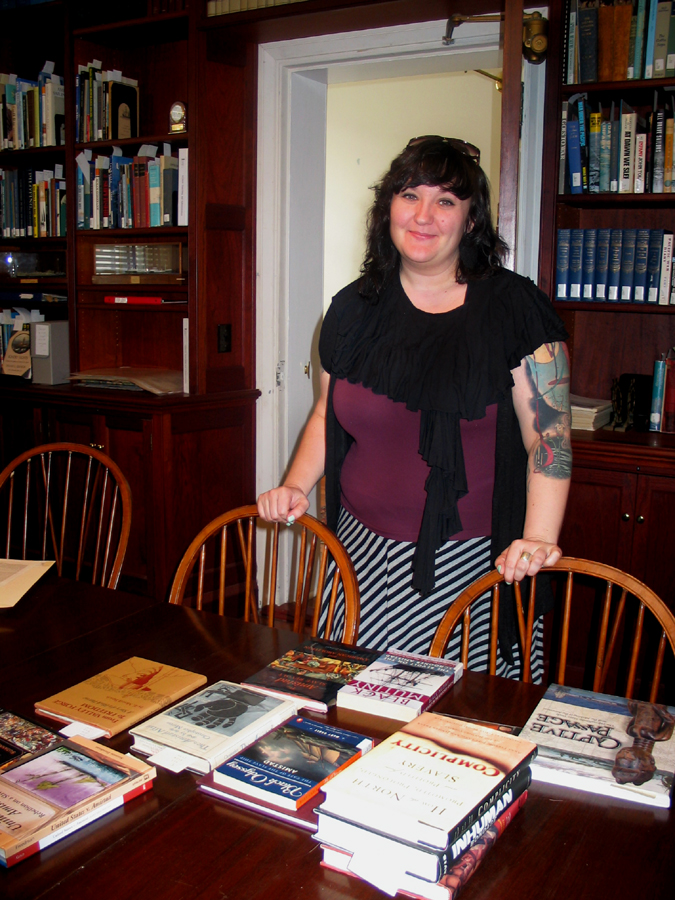
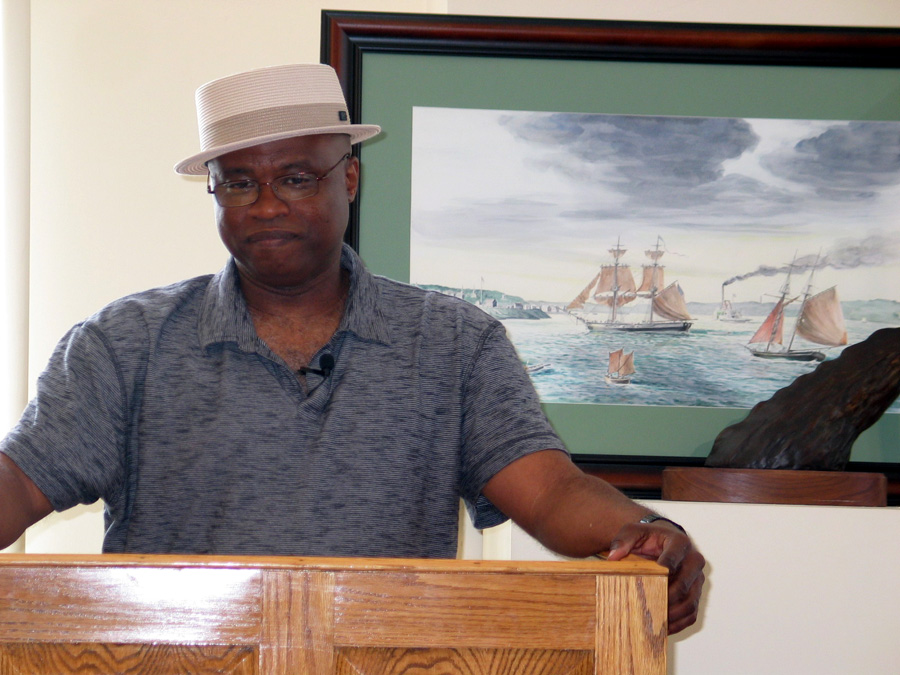
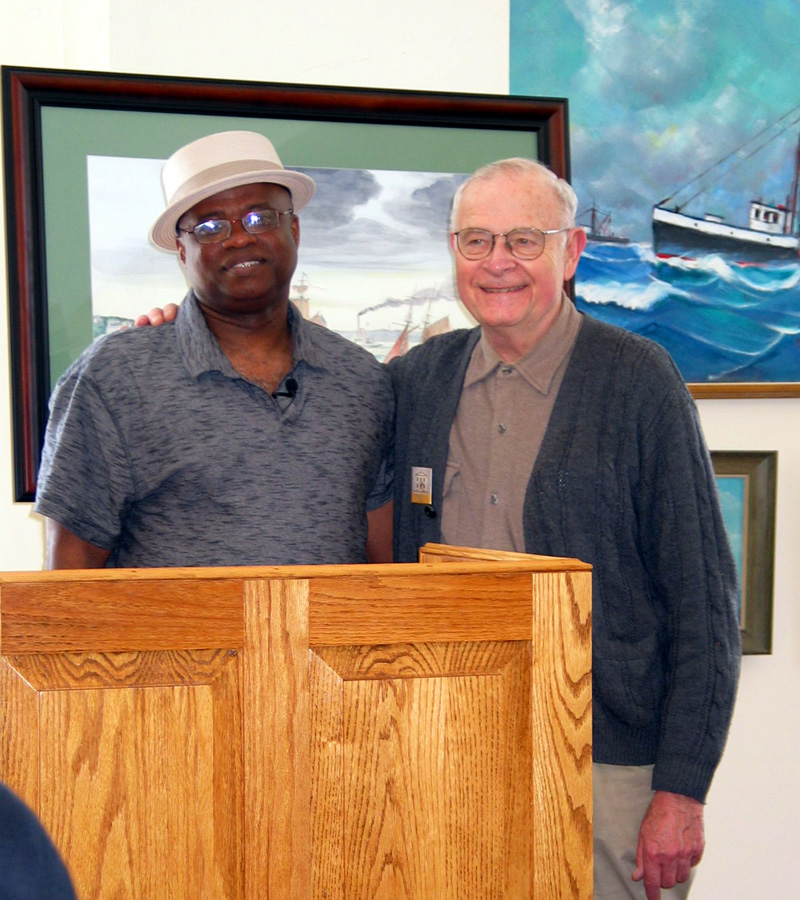
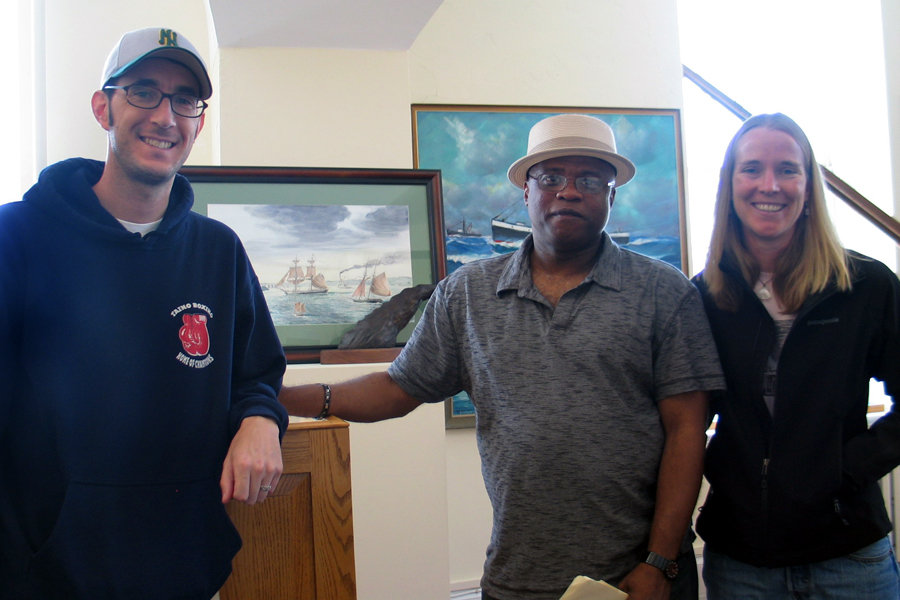
Both historian Michelle Morgan and poet Randall Horton worked with head docent Bill LaRoue and librarian Brian Rogers to research their works.
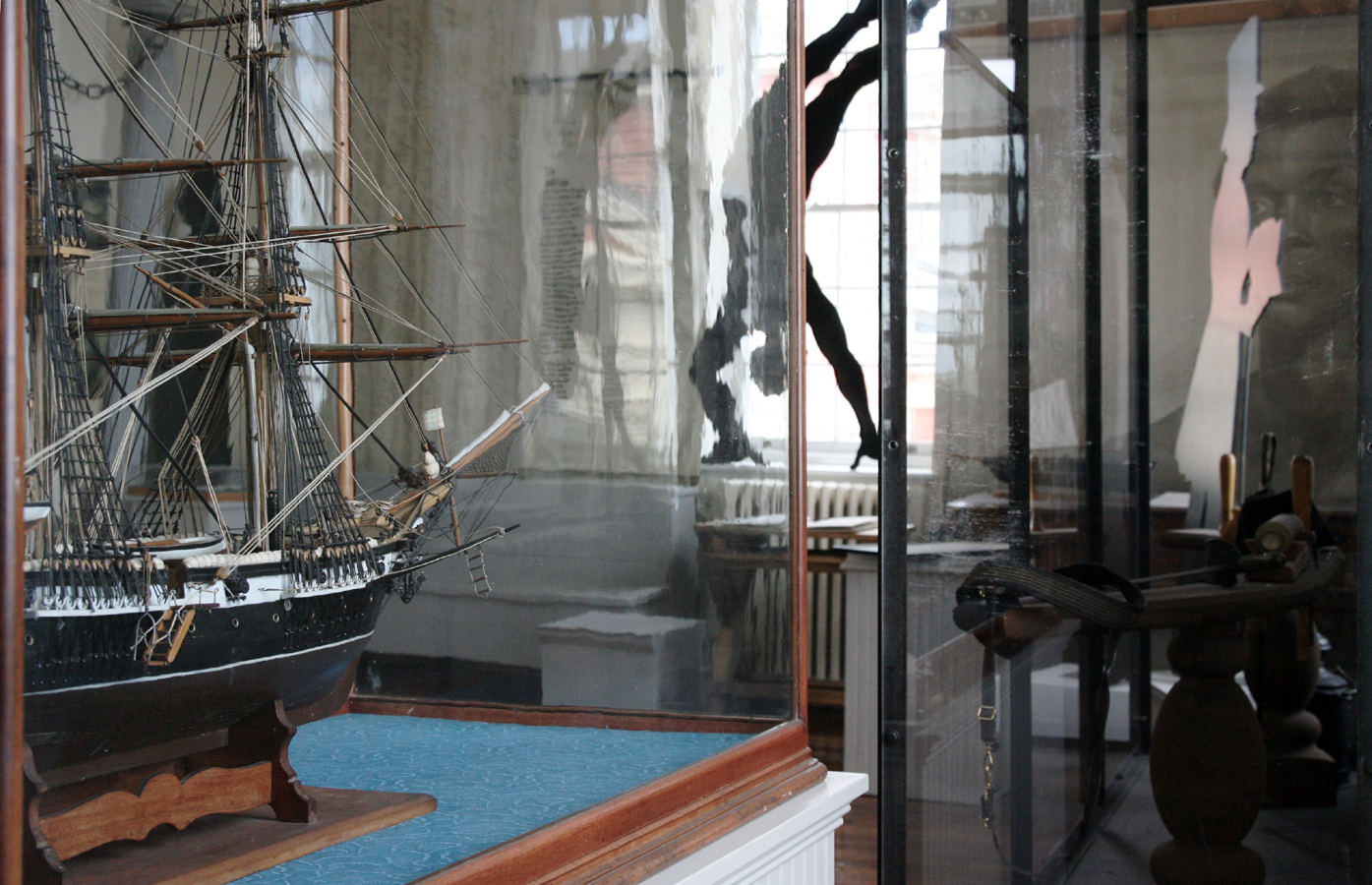
The Custom House is a Connecticut Freedom Trail site.
Salvage History Meditation
by Michelle Morgan
Perhaps it is because I grew up in the late twentieth century. Perhaps it is because I grew up in the late twentieth century in a wooded corner of New England, and not on the coast. Maybe it is from sheer ignorance. Whatever the cause, before May 5, 2011, the day I visited the New London Maritime Museum, I only knew one meaning of the word salvage. As far as I was knew, salvage was the stuff you picked through at a yard sale, or the leftovers remains from a flood or fire somewhere in the Midwest, shipped to the local who-knows-what-you’ll-find store to be bought for cheap.
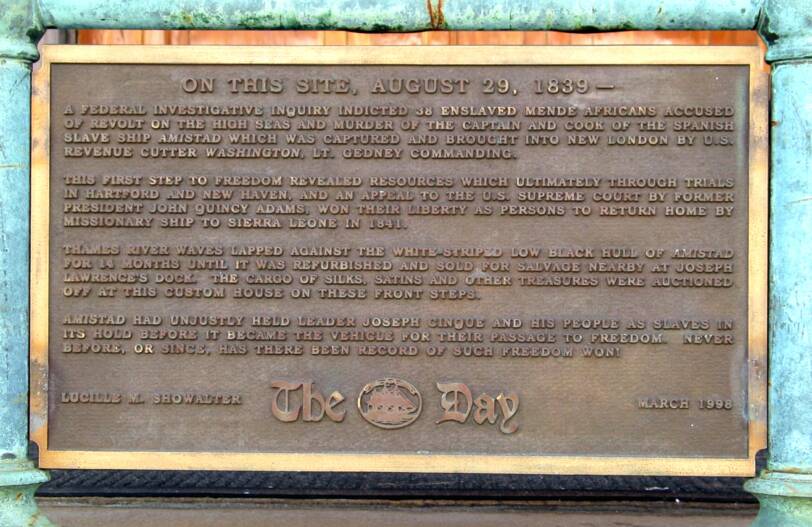
This definition of salvage is what I had in mind when I came across a reference to “salvage law” in the New London Maritime Museum’s collections. The story ran thus: having encountered La Amistad off the shore of Long Island, Captain Gedney towed the ship into New London rather than
New York, hoping to secure salvage rights. He would, in other words, earn a profit of the property value of the goods he “saved” from the ship. Since slavery was illegal in New York but not Connecticut, Gedney, allegedly, hoped Connecticut courts would consider the Mendian people onboard property and award him a percentage of their value. Salvage, I learned, is not just the property saved from a fire (or shipwreck); it is also—according to dictionary definitions and naval law—compensation for that property, based on a property’s determined value or worth.
What constituted property was constantly up for grabs during the early years of commodity capitalism and throughout the nineteenth century. Who could own property and who could not cut to the very heart of slavery—at its most basic level, white men could own property, and most others could not. Not being entitled, legally, to hold or own property of course did not necessarily make one property—
although, using the language of property, white suffragists and women’s rights advocates throughout the century
frequently made recourse to precisely this analogy between white women and slaves. Property was a key component of individuation and signified the right to own— literally—property in oneself. This possessive individualism was linked, from there, to citizenship rights, which, tautologically and fatalistically, determined who could own property. For enslaved African Americans, property in oneself was a legal impossibility.
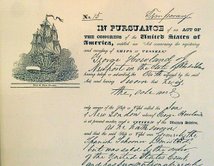
How fitting, then, that Gedney pulled La Amistad into New London, docking at Lawrence Wharf only feet from the U.S. Custom House. In 1839, the Custom House sat directly on the water. Maps from the period show a bit of water immediately adjacent to the building, where small boats could “park” at the Custom House and do business, declaring their imports and exports in this busy Connecticut port. These imports and exports, of course, were future properties—either goods or
materials that would be made into goods for sale here in the United States, or goods or materials that would be made into goods destined for foreign ports and lands.
From the moment La Amistad was dragged into New London, the press was obsessed not just with its human inhabitants, but with the goods it was carrying. The New London Gazette and General Advertiser wrote on Wednesday, August 28, 1839:
Over the deck were scattered in the most wanton and disorderly profusion, raisins, vermicelli, bread, rice, silk and cotton goods. In the cabin and hold were the marks of the same wasteful destruction. Her cargo appears to consist of silks, crapes, calicoes, cotton and fancy goods of various descriptions, glass and hardware, bridles, saddles, holsters, pictures, looking glasses, books, fruits,
olives and olive oil, and “other things too numerous
to mention”— which are now all mixed in a strange and fantastic medley. On the forward hatch we unconsciously rested our hand on a cold object,
which we soon discovered to be the naked corpse, enveloped in a pall of black bombazine.* On removing its folds we beheld the rigid countenance and glazed eye of a poor negro who died last night.
His mouth was unclosed and still were the ghastly expression of his last struggle.
The description of properties and goods “wasted” was undoubtedly at least a partial figment of a biased reporter’s imagination. Many of the Mendians onboard were starving or had died after ingesting lethal quantities of liquid medications, not suitable for consumption, in efforts to slake their thirst. Likewise, early accounts of La Amistad noted that the people on board had traded with other ships they encountered for goods like apples, an unlikely necessity if fruits had been “scattered” across the ship in disarray. The press, in other words, made it clear from the beginning
that “property” had no clear idea of how to use property properly, even something as fundamental as foodstuffs. It is in these small, salvaged formulations of language, and in the stories told about people, that the deepest aspects of ideological reasoning surface.
This same newspaper article began by relaying further eyewitness testimony to Gedney’s initial visit to the ship. It states:
On her deck were grouped amid various goods and arms the remnant of her Ethiop crew, some decked in the most fantastic manner in the silks and finery pilfered from the cargo, while others in a state of nudity, emaciated to mere skeletons, lay coiled upon the decks. Here could be seen a negro with white pantaloons and the sable shirt which nature gave him, and a planter’s broad-brimmed hat upon his head, with a string of gewgaws around his neck, and another with a linen cambric shirt, whose
bosom was worked by the hand of some dark-eyed daughter of Spain, while his nether proportions were enveloped in a shawl of gauze or Canton crape.
The New London Gazette depicted a pantomime of property relations in its representation of the ship, its crew, and its cargo, with the Mendians either incapable of properly using and distributing the things among the people onboard or else, in the typical language of the time, “mimicking” the dress customs of their enslavers (if and when they were dressed at all). They are presented as having no proper use for the rich materials onboard, except as means for making spectacles out of themselves.
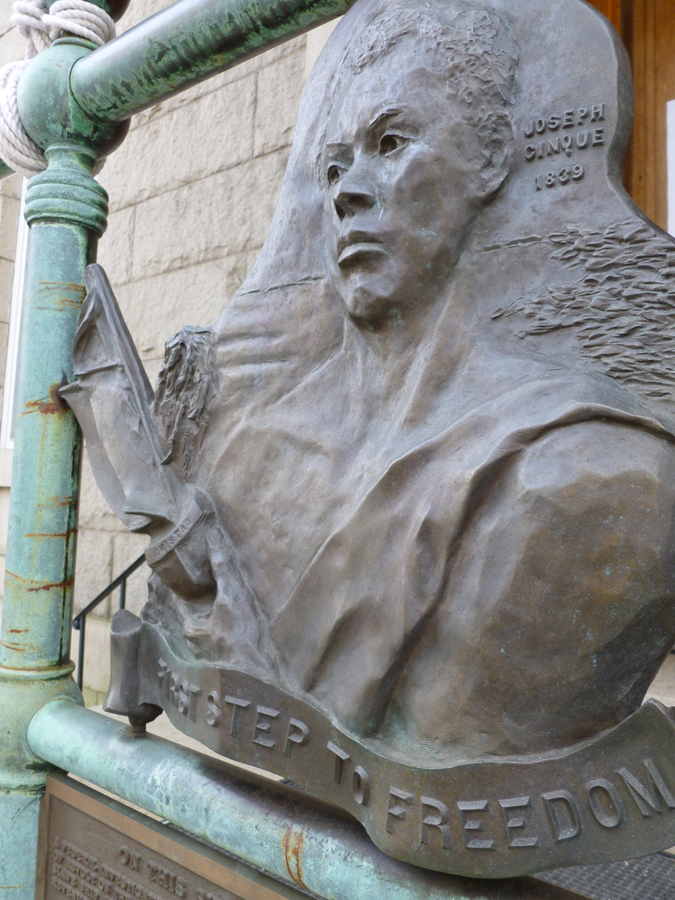
Gedney, of course, would not get his salvage compensation for the men, women, and children onboard the ship. Eventually Cinqué and his shipmates returned to Mende. But still the battle over the cargo and its worth waged on. For years cries for or against indemnity ricocheted around the halls of the Capitol, as the Cuban schooner and its Spanish owners pressed for recompense for the lost ship and its cargo. A decade later President Polk was still pushing to pay the Spanish government fifty thousand dollars. As David Brion Davis writes in his book Inhuman Bondage: “until the Civil War, the U.S. government was plagued by continuing disputes over Spanish claims and demands for monetary compensation. The Amistad affair underscored the interrelationship with the Atlantic Slave System, from a ship built on an American model… to an 1844 House of Representatives committee report that attacked the Supreme Court’s decision and called for payment of indemnity to Spain, an action that reflected the South’s growing interest in acquiring Cuba. Similar moves for indemnity payment were made in the Senate, and President Polk, in his address to the nation of December 9, 1847, in the midst of the Mexican War, called for appropriations to pay Spain for the value of the Amistad “slaves” as the only way of restoring friendly relations between the two nations” .
What Davis identifies as “interrelationships” between the United States and Spain regarding trade and economic systems, slavery, and the desire to “acquire” more land and its slave population is rightfully crucial to the stories we narrate about U.S. national history. Yet in many ways, the
attention paid to the relationship between Spain and the United States in the wake of the Amistad affair has been “salvaged” by history and historians repeatedly. Less often told is the story of the Mendian’s property—for surely they owned property in themselves at the very least. It is probably
true that each Mendian onboard La Amistad would have been stripped of any tangible property of value. But I wonder, as I think about the remains of things that circulate in museums and in historical society collections and libraries, and as I think about the ways so much history has a tendency to overlook the very remains and salvage it cannot immediately account for in larger systematic political structures or explanations of social behavior, about the small things these people might have found ways to hold close to them as they were packed into the schooner. Less is made,
for example, of why the Mendians were not allowed “salvage compensation” for the ship when it was auctioned fourteen months after their initial capture, or why they were forced to raise funds for their return to Mende rather than using the proceeds of the auctioning of the ship and its cargos as fair due for their trials. Of course this is just wishful thinking on my part, this imagining that people who were barely given their freedom might actually be compensated for the atrocities they suffered.
But this wishful thinking should not blind me to the other small bits of property that might actually show up in these accounts. What was the “string of geegaws” the New London Gazette reported noted as hanging from one of the Mendian’s necks? Was it some “valueless” thing? To whom was it valueless? Gedney? History? As I read the reporter’s atrocious account of Gedney’s first encounter with La Amistad and its crew, it strikes me that this is not the only mention in the archive of a small, “worthless” piece of
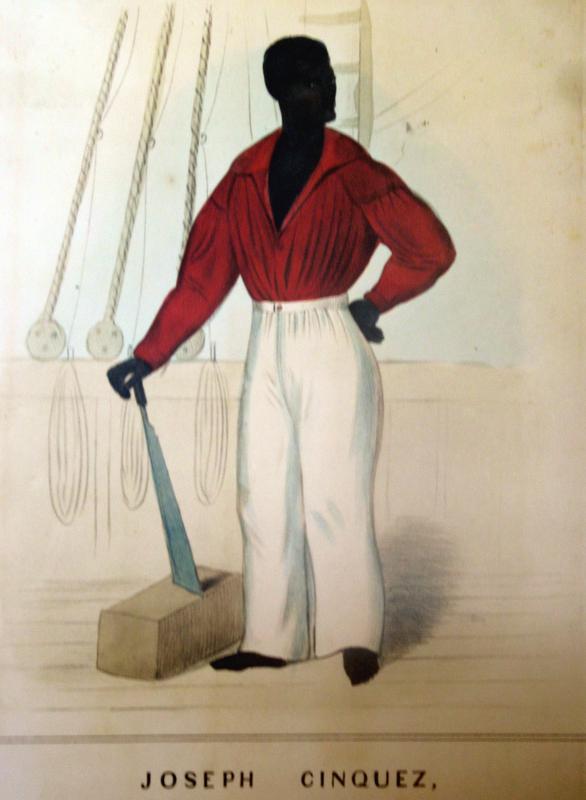
property. In an early account of the Amistad affair by John Warner Barber, A History of the Amistad Captives (1840), Cinqué is described as entering Gedney’s cabin, on the U.S.
cutter Washington, “manacled… [with] a cord around his neck, to which a snuffbox was suspended” (6). Here is the salvaged history of a small item Cinqué claimed as his, and yet again it is positioned as threatening. A snuffbox, suspended from a cord, which hung around his neck. Images of lynching are barely concealed beneath the surface of this passage—the only piece of property Cinqué owns, besides himself, appears around his neck, ready to “snuff” him out, as he is brought, manacled and under arrest, into the cabin of Capt. Gedney. Did that snuff box contain snuff produced by the hands of slaves in the tobacco fields of Cuba? Was the cord made of cotton or hemp? Either could have been made by slave labor, as well.
I cannot linger too long on the implications of this passage, where even this tiny, “worthless” bit of property was likely made by enslaved humans. Instead, I have to think about it
from another, more positive view of salvage: as what remains unexamined in the archive and as something more valuable than anyone might have previously recognized. This snuffbox on a cord might just be the umbilical cord tying Cinqué to other black bodies, a thread running like a vein of blood through arms and wrists, challenging the ways slavery reduces what it deemed “valueless” to the salvage bins of history.